
A recurring mistake in enterprise AI initiatives is building complex multi-agent systems for problems that a well-configured single LLM could handle. The opposite failure is equally common: forcing a single-model pipeline onto tasks that fundamentally require multi-domain coordination.
Both are costly. The first squanders engineering time without commensurate ROI. The second produces systems that are brittle, unscalable, and difficult to maintain. The strategically relevant question is not "multi-agent or not" — it is when the complexity of agent orchestration is worth the cost and risk it introduces.
Capabilities and Limits of a Single LLM
Modern LLMs with tool-use capability handle a broad range of tasks: document-based question answering, structured information extraction, content drafting, query execution, even multi-step analysis within a single context window. For many enterprise use cases — internal knowledge assistants, document summarizers, tier-1 customer service — a single model is sufficient.
The strength of a single LLM is its simplicity: one model, one context, one control point. Debugging is straightforward, costs are predictable, and governance is manageable. Engineering teams need not build orchestration infrastructure, and organizations need not define inter-agent interfaces.
Four conditions, however, expose the fundamental limits of a single-model approach:
- Context window exhaustion: Processes requiring accumulated information that exceeds the model's window — analysis across hundreds of documents, multi-month project coordination, continuous monitoring pipelines.
- Domain conflict: Tasks requiring mutually incompatible specializations — a single model cannot simultaneously serve as a legal expert, a financial analyst, and a technical architect without quality degradation.
- Parallelism: Work that can logically proceed concurrently is forced into a sequential queue, creating unnecessary throughput bottlenecks.
- Specialization depth: Tasks requiring fine-grained calibration — distinct tones for distinct audiences, varying output standards by domain — are difficult to govern within a single system prompt.

When Multi-Agent Is the Right Answer
Multi-agent architecture is not a universal solution — it solves a specific class of problems. Four strong signals indicate that orchestration is warranted:
1. Complexity that spans multiple domains of expertise. Processes that require simultaneous input from distinct specializations — risk analysis drawing on legal, financial, and technical perspectives at once — are strong multi-agent candidates. Each domain can be represented by an agent with its own calibrated context.
2. Tasks that parallelize meaningfully. When a workflow decomposes into independent sub-tasks that can run concurrently — market research across five industry segments simultaneously, or parallel processing of hundreds of documents — multi-agent delivers significant throughput advantages.
3. Internal cross-checking and validation requirements. For high-stakes decisions, a dedicated validator agent reviewing another agent's output from an independent perspective produces reliability that far exceeds single-model self-review.
4. Persistent, long-running operations. Continuous monitoring pipelines, workflows running over multiple days, or systems that must react to events from multiple sources concurrently — these are domains where agent architecture is architecturally superior.
Orchestration Patterns Relevant for Enterprise
In practice, three orchestration patterns are most frequently applicable:
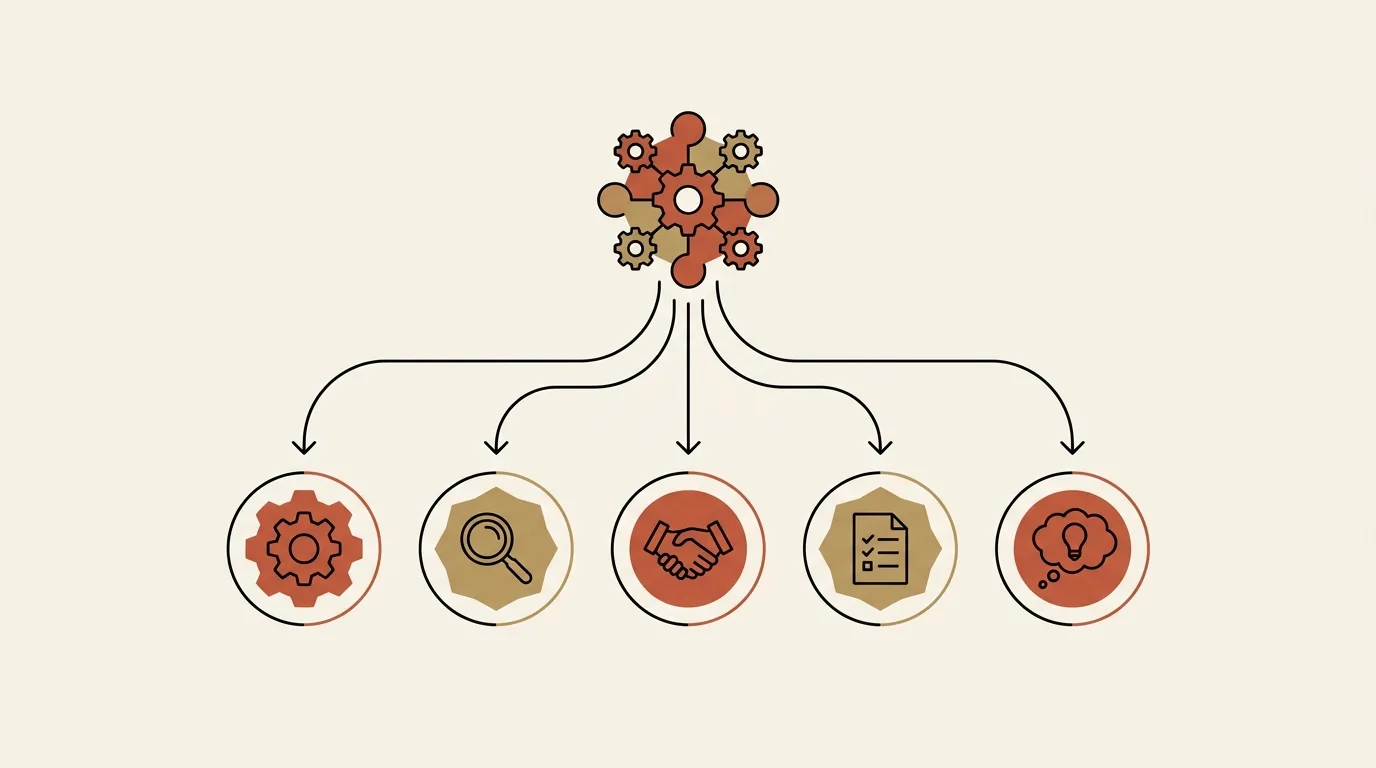
Hierarchical orchestration positions a coordinator agent (orchestrator) that receives high-level objectives, decomposes them into sub-tasks, and delegates to specialist agents. The orchestrator does not execute technical work — it plans, delegates, and aggregates. This pattern fits complex business processes with many sequential stages.
Parallel specialist pattern deploys multiple agents with distinct specializations working concurrently on different facets of a problem, with an aggregator agent combining the results. This pattern delivers speed and analytical depth advantages.
Critic-executor pattern pairs an executor agent with a critic that independently evaluates outputs before results are passed downstream. This pattern materially improves accuracy for use cases where errors carry significant consequences — compliance review, legal drafting, financial analysis.
The question is not which model is best — it is when a single agent is no longer enough.
Hidden Costs of Multi-Agent That Are Often Overlooked
The decision to build a multi-agent system must account for costs that do not always surface in initial evaluations:
- Coordination overhead: Every inter-agent communication consumes tokens and latency. An overly granular system — too many small agents — can be slower and more expensive than a comparable single-model approach.
- Observability complexity: Debugging multi-agent systems is substantially more involved. You need logging capable of tracing decisions across agents, reconstructing reasoning chains, and identifying failure points within a long pipeline.
- State management: Maintaining consistent state among agents running in parallel requires careful design. Race conditions and data inconsistencies are real risks that must be anticipated at design time.
- Engineering overhead: Teams building their first multi-agent system routinely underestimate the time required for orchestration, error handling, and production-grade retry logic.
Decision Framework: Three Defining Questions
Before committing to an architecture, three questions must be answered honestly:
- Can the use case be solved by a well-prompted single model? If yes, start there. Add complexity only when there is concrete evidence that a single model is insufficient.
- Does the team have the capability to build and maintain orchestration? A multi-agent system that is poorly maintained is more dangerous than a simple system that runs reliably.
- Do the benefits — speed, accuracy, scale — quantifiably exceed the additional cost? This estimate must be grounded in real numbers, not optimistic assumptions.
The Pragmatic Path: Start Simple, Scale on Evidence
The most successful enterprise deployments begin with the simplest architecture that can prove value — often a single LLM with tool-use — and identify real bottlenecks that warrant multi-agent treatment.
The transition to multi-agent is incremental: extract the one bottleneck into two separate agents, validate the result, then continue. Architecture built on empirical evidence is far more sustainable than architecture designed in full upfront from assumptions.
For enterprises beginning their agentic AI journey, this distinction separates deployments that deliver measurable ROI within six months from pilot projects that never find their way to production.
Topics