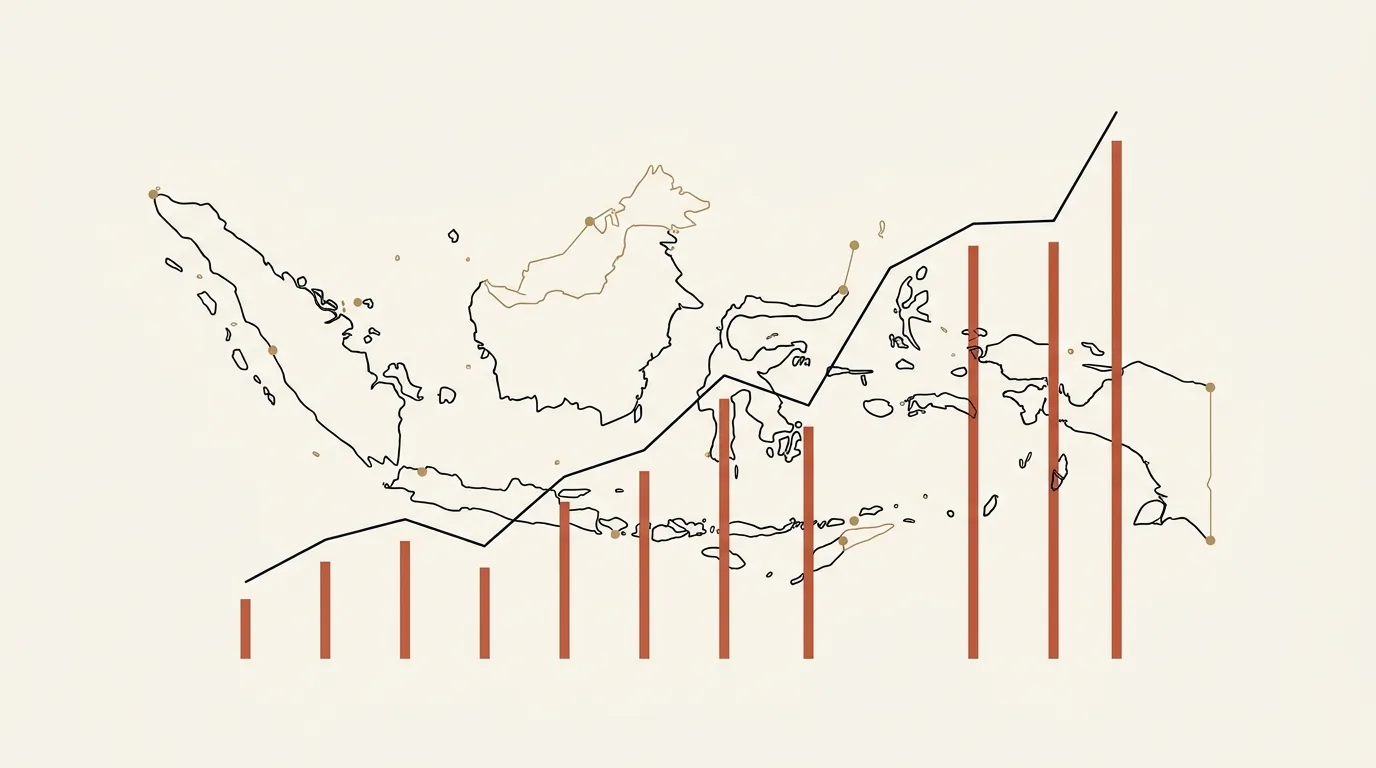
A strategic question surfacing across CDO agendas in Indonesia this year is deceptively simple: where does our organization actually stand in agentic AI adoption relative to global benchmarks — and what must we do in the next twelve months to avoid falling behind without burning budget on technology that has yet to mature?
A credible answer requires three layers of data: the global state of adoption, Indonesia's relative position, and differentiation across sectors. This piece synthesizes those three layers drawing on current industry research and field observations from enterprise engagements in Indonesia.
Global Agentic AI Adoption: From Experimentation to Production
McKinsey's The State of AI: How Organizations Are Rewiring to Capture Value (2025) reports that 78 percent of organizations globally are now using AI in at least one business function — up from 55 percent in 2023. More significant, however, is the shift in usage category: from generative AI for individual productivity toward agentic AI for workflow automation involving multiple steps, access to internal systems, and conditional decision-making.
Gartner's Hype Cycle for Artificial Intelligence, 2025 positions AI agents at the Peak of Inflated Expectations, with mainstream adoption estimated two to five years out. This phase has important characteristics for decision-makers: market expectations outpace the capability of average implementations, yet successful production cases are beginning to emerge in pioneer sectors.
IDC's Worldwide AI and Generative AI Spending Guide projects global agentic AI spending to reach USD 47 billion by 2030, at a compound annual growth rate of 41 percent from 2024. Spending is concentrated in three sectors — financial services, healthcare, and technology — with financial services accounting for nearly a third of early total expenditure.
What matters from this global data is not the headline figures. What matters is the character of adoption: agentic AI is neither waiting for mainstream nor already commoditized. Organizations building capability now are establishing internal patterns that will translate into operational advantage over a three-to-five-year horizon.

Indonesia's Position: Asymmetric and Sector-Dependent
Indonesia lacks a direct equivalent of the McKinsey State of AI benchmarks. What is available is general AI adoption data from several sources: Microsoft's AI in Asia Pacific (2024), KADIN Indonesia's AI Readiness Index (2024), and the IDC ASEAN tracker. Triangulating these sources reveals an asymmetric picture.
First, the level of general AI adoption among mid-sized Indonesian enterprises sits at roughly 30 to 40 percent — approximately 18 to 24 months behind the global benchmark. This figure masks significant variance across sectors.
Second, the sectors leading adoption are financial services (mid-to-large banks and mature fintechs), telecommunications, and e-commerce platforms. These pioneer sectors share common characteristics: high data volume, mature cloud infrastructure, existing engineering talent, and sufficiently clear regulatory guidance — OJK for banking, BSSN for telecoms.
Third, the sectors trailing behind include traditional manufacturing, property, private healthcare, and most non-financial SOEs. Common characteristics here: dominant legacy systems, cloud infrastructure still in transition, scarce AI engineering talent, and sector regulation still taking shape.
Specifically for agentic AI — as distinct from general AI — the gap between pioneer and laggard sectors widens considerably. Field engagements indicate that even within pioneer sectors, the majority of organizations remain at the pilot stage, with fewer than 15 percent having deployed agents to production with adequate governance and observability.
Three Structural Barriers to Agentic AI Adoption in Indonesia
Based on enterprise engagements across Indonesia and trends consistent with BCG's Where's the Value in AI? (2024), three structural barriers emerge with regularity.
First barrier: regulatory ambiguity. The Personal Data Protection Law (UU No. 27/2022) has been enacted, but secondary regulations governing AI systems that process personal data remain incomplete. PSE registration with Kominfo represents one friction point with unclear positioning for AI vendors and enterprise clients. This ambiguity is driving many organizations toward a wait-and-see posture, particularly for high-stakes use cases.
Second barrier: data sovereignty and residency. Most enterprise-grade agentic AI workloads rely on models from global providers — Anthropic, OpenAI, Google — where inference occurs outside Indonesia. For clients in regulated sectors, this raises compliance questions that lack standardized answers. A well-tested architecture pattern combines global models for non-sensitive inference with local or private endpoints for sensitive data — but this pattern remains rare outside financial services.
Third barrier: talent gap. McKinsey's Tech Trends Outlook 2025 estimates a global shortage of production-grade AI engineers at 60 to 70 percent of demand. In Indonesia, this gap is likely larger given the relatively nascent AI engineering ecosystem. The scarce profile is not a generalist AI/ML engineer, but an engineer who has deployed multi-agent systems to production with observability and governance — a competency that is only now developing even in more advanced markets.
Indonesia's position is not about being behind — it is about being at a defining decision point.
Sector Differentiation: Not All Use Cases Are Equally Mature
Decision-makers often commit a generalization error: treating all agentic AI use cases as equally mature. The field reality is more nuanced.
Use cases already mature for Indonesia. Document-intensive workflows in the legal, insurance, and banking sectors already have well-tested architecture patterns: retrieval-augmented generation with citation traceability, hybrid retrieval combining semantic and lexical approaches, confidence thresholds, and fallback paths. Use cases in this category have a relatively clear path to production.
Use cases still emerging. Customer-facing conversational agents for financial transactions, autonomous agents for infrastructure operations, and multi-agent systems for complex decision-making. These have successful pilots at several enterprises, but production deployment still requires significant investment in guardrails, governance, and human-in-the-loop patterns.
Use cases still speculative. Fully autonomous agents for strategic business decisions, agent-to-agent negotiation across organizations, and self-improving agents with minimal human oversight. There is insufficient production reference to justify enterprise investment at this time.
Sound decision-makers distinguish these three categories when building their roadmap. Investment in mature use cases delivers ROI within a six-to-twelve-month cycle. Emerging use cases require patience and managed expectations. Speculative use cases are best approached as bounded experiments with limited budgets.
Inflection Point: Indicators to Watch in 2026–2027
Several indicators are worth monitoring to read the phase shift in Indonesia's adoption trajectory.
First, the completion of secondary UU PDP regulations specific to AI systems. If Kominfo and sector regulators publish sufficiently detailed guidance within the next 12 to 18 months, regulatory ambiguity decreases materially and enterprise adoption in regulated sectors can accelerate.
Second, the entry of AI models hosted regionally in Indonesia or Southeast Asia from global hyperscalers. Regional endpoints reduce data residency friction and latency, opening a path for use cases previously constrained by these factors.
Third, talent ecosystem development. If formal education programs and private bootcamps begin producing AI engineers with production-grade competencies within the next 12 to 24 months, the talent barrier eases and engagement costs fall meaningfully.
Fourth, the emergence of two or three Indonesian case studies publishing concrete metrics — latency, accuracy, cost per inference, ROI — from pioneer sectors. Concrete case studies become the references used by procurement and vendor selection committees across other sectors.

Implications for Decision-Makers
Three practical implications emerge from this analysis for CTOs, CDOs, and COOs of Indonesian mid-corps building their AI roadmaps.
First implication: prioritize mature use cases. Initial agentic AI investment should be allocated to document-intensive workflows with a proven path to production. The internal capabilities and governance built through these engagements become the foundation for tackling more complex use cases.
Second implication: build an evaluation framework before vendor selection. The AI vendor market in Indonesia currently shows significant quality variance between firms with production experience and those newly entering the market. Procurement that evaluates vendors without a clear framework risks selecting based on demos — which rarely reflect production behavior. Relevant evaluation criteria will be addressed in the next Insights edition under the Implementation Practice pillar.
Third implication: plan governance in parallel with implementation. Observability, audit trail, and human-in-the-loop patterns are not add-ons bolted on after the agent runs — they are foundations that must be designed from the earliest phase. Organizations that lead with governance have demonstrably faster paths to production compared to those that retrofit governance retroactively.
Enterprise agentic AI adoption in Indonesia sits at an interesting inflection: too early to be considered mainstream, yet mature enough for specific use cases in specific sectors. Decision-makers who build their roadmaps with use-case category differentiation, a solid evaluation framework, and governance designed from the start will hold material operational advantage within a 24-to-36-month horizon.
The engineering and solution architecture team at PT Widigital Tri Buana implements agentic AI for Indonesian enterprises with a focus on mature use cases and production-grade governance. To discuss an engagement, contact our team at widigitaltribuana.com.
References
- McKinsey & Company. The State of AI: How Organizations Are Rewiring to Capture Value. McKinsey Quarterly, 2025.
- Gartner. Hype Cycle for Artificial Intelligence, 2025. Gartner Research.
- IDC. Worldwide AI and Generative AI Spending Guide. International Data Corporation, 2025.
- BCG. Where's the Value in AI?. Boston Consulting Group, 2024.
- McKinsey & Company. McKinsey Technology Trends Outlook 2025. McKinsey Digital, 2025.
Topics