Notes from production.
Field observations, architecture analysis, and engineering reflections from building AI systems that run in production.

Seven Criteria for Production-Grade AI Agents in the Enterprise
Seven production-grade criteria for enterprise AI agents — observability, audit trail, fail-safe, cost governance, and human-in-the-loop, anchored to NIST AI RMF and ISO/IEC 42001.
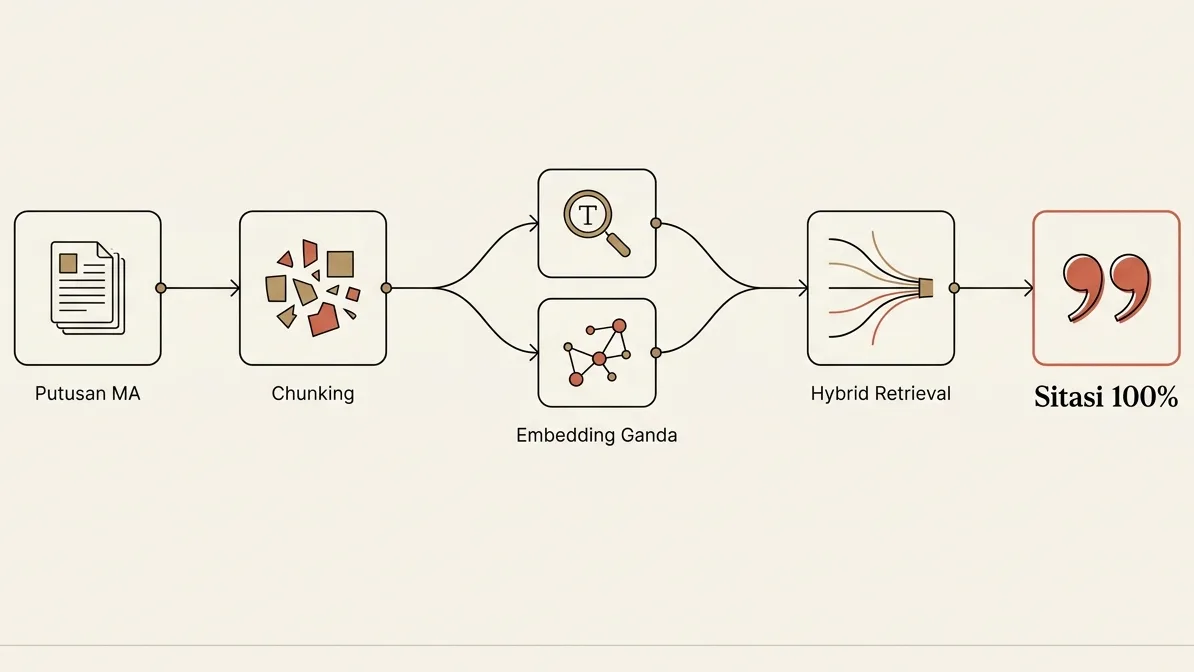
Pengacara-ku — Hybrid RAG Architecture for Indonesia's Legal Knowledge Domain
A deep-dive into Pengacara-ku's architecture — hybrid RAG over 18,000+ Indonesian court decisions. Ingestion, chunking, retrieval, citation traceability, and generalizable patterns for regulated sectors.

What Is an AI Agent? Distinguishing Agentic AI from Chatbots, RPA, and Automation
An AI agent is not simply a smarter chatbot — it is a system that plans, decides, and executes multi-step tasks autonomously.

Multi-Agent vs. Single LLM: When Enterprise Actually Needs Agent Orchestration
A single LLM suffices for many use cases. Multi-agent orchestration earns its complexity only when task scope, domain breadth, or scale surpass what one model can reliably deliver.
Why AI Agent Pilots Fail in Production — and How to Close the Gap
An impressive AI agent demo does not guarantee a reliable production deployment. These are the structural gaps most consistently overlooked in the transition.

AI Agent Governance for Enterprise: Observability, Audit Trail, and Human-in-the-Loop
Without proper governance, a powerful AI agent becomes a system that cannot be audited, cannot be trusted, and carries unacceptable operational risk.
Calculating Agentic AI ROI: A Business Case Framework for Decision-Makers
Agentic AI ROI cannot be reduced to cost savings alone. A complete framework must account for capacity liberation, quality uplift, and option value.
- Industry Insight
- Implementation Practice
- Case Reference
Have a specific topic to discuss?
We open a short session to map the relevant issues for your organization. Response within one business day.